


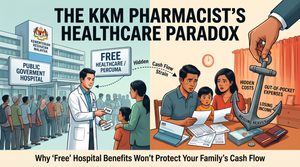
Every working day inside a Ministry of Health (KKM) hospital, you see what modern medicine really costs.
You review outpatient prescriptions, verify chemotherapy regimens in the Cytotoxic Drug Reconstitution (CDR) cleanroom, and sign off on biologics that cost thousands of ringgit per vial. You understand pathophysiology, treatment cycles and adverse drug reactions better than almost anyone in the country.
Yet when I review the protection plans of government pharmacists under the Public Service Remuneration System (SSPA, Gred UF9 to UF14), I keep meeting the same paradox: clinical medication experts who believe a health crisis cannot do them real financial harm.
The reasoning is always identical:
“I work for KKM. Under Perintah Am Bab F, my treatment at government hospitals is free. Even on sick leave, my salary keeps coming. Why pay for private critical illness or medical insurance?”
It sounds like ironclad logic, and half of it is true. Free hospital care covers your bed, your surgery and your formulary drugs. Approved sick leave keeps your basic salary and most fixed allowances flowing.
What neither covers is everything around the illness: pay that stops within weeks, a spouse who may have to stop working, and treatment outside the standard formulary.
A government hospital pays for your treatment, and the civil service keeps your salary running during approved sick leave. But neither will replace your BIPK and on-call income once leave passes 28 days, fund a drug outside FUKKM, or replace your spouse’s income if they must stop working to care for you.
The Four Hidden Traps in Civil Service Healthcare
KKM medical benefits (Perintah Am Bab F) and paid sick leave (Perintah Am Bab C) are a generous safety net. Relying on them as your only protection still leaves four gaps.
1. The FUKKM approval gap
As a hospital pharmacist you know that not every cutting-edge therapy is available in a KKM facility. KKM hospitals may only use medicines listed in the Formulari Ubat KKM (FUKKM), within its listed indications and prescriber categories. Many targeted therapies and oncology biologics are restricted to certain specialists (the A* prescriber category) or are not listed at all.
Using a drug outside FUKKM needs approval from the Director-General of Health through a Ubat Kelulusan Khas (UKK) request, usually filed as a named-patient application. Approval is decided case by case. If you or a family member wants a treatment that is not approved, or wants it sooner, the bill is paid from your own cash.
2. Your pay packet shrinks after 28 days
Approved sick leave keeps your basic salary coming, but not everything on your payslip. Under the service circulars on critical service payments (PP 17/2007 and PP 4/2009), BIPK stops once your sick leave exceeds 28 consecutive days. For pharmacists, BIPK is a fixed RM750 a month under SSPA, so that is RM750 gone from the second month.
Variable income stops even sooner. On-call and extended-hours claims, and any approved locum shifts, end the day you cannot work. Fixed allowances such as ITP and ITKA generally continue during full-pay leave, but confirm with your payroll unit.
If you do outside work, remember that civil servants need Head of Department approval for it. That income only counts as part of your cash flow if it is approved.
3. The caregiver income shock and ancillary costs
When a healthcare professional suffers a severe stroke, cardiac event or advanced cancer, hospitalisation is only the beginning. The heaviest financial drain comes after discharge:
- The caregiver drain: a spouse often takes extended unpaid leave (Cuti Tanpa Gaji) or quits to provide round-the-clock care and drive to appointments. Your household suddenly loses an income stream.
- Specialised rehabilitation: private physiotherapy, occupational therapy and speech therapy to speed recovery beyond limited public clinic slots.
- Consumables and equipment: enteral feeds, oncology nutrition, wound dressings, hospital beds, oxygen concentrators and home modifications are not covered by a government guarantee letter.
4. The extended-illness cliff
Sick leave is generous, but it has limits:
- Up to 180 days a year on full pay. Per the Perintah Am Bab C leave rules, the first 90 days are approved by your Head of Department and a further 90 at a higher level.
- Longer full-pay leave for cancer. Cancer and leprosy cases can qualify for up to 24 months on full pay while treatment continues, and TB up to 12 months, according to university HR guides summarising the rules.
- Then half pay. After a Medical Board assessment, extended sick leave of up to 90 days on half pay can follow.
If a Medical Board (Lembaga Perubatan) certifies that you cannot perform your duties, you can be retired on health grounds (Persaraan Atas Sebab Kesihatan) under the Pensions Act 1980. Since 1 January 2018 these benefits have been enhanced: officers with short actual service are credited with notional service when the pension is calculated, and the minimum pension is one-fifth of final salary.
That is a real improvement. But a pension is still a fraction of a full salary, and a mid-career pension sits well below what a full career would pay. Your family’s living costs and illness costs do not shrink to match it.
KKM Benefits vs. a Standalone Critical Illness Policy
KKM benefits cover treatment and basic pay, while a critical illness (CI) lump sum covers everything around them.
| Protection dimension | KKM benefits (Perintah Am Bab F and Bab C) | Standalone critical illness policy |
|---|---|---|
| Inpatient treatment at KKM hospitals | Covered | Not its role (a medical card’s job) |
| Basic salary during approved sick leave | Paid: full pay up to 180 days; longer for cancer | Not applicable |
| BIPK (RM750 a month) | Stops after 28 consecutive days of sick leave | Replaced from the lump sum |
| On-call, extended-hours and approved locum income | Stops when you cannot work | Replaced from the lump sum |
| Spouse’s lost income | No compensation | Replaced from the lump sum |
| Drugs outside FUKKM | Needs UKK approval, decided case by case | Your choice, paid from the lump sum |
| Private care and second opinions | Not covered | Free to choose, paid from the lump sum |
| LHDN tax relief | Not applicable | Premiums claimable (see Rule 2 below) |
The Mathematics of a Severe Health Event
A cancer diagnosis can leave a household with a six-figure cash deficit even when the government salary never stops.
Consider a 34-year-old KKM pharmacist with a gross monthly income of RM8,000 (basic salary, BIPK of RM750 and fixed allowances). The figures below are for illustration. A cancer diagnosis brings 18 months of treatment, surgery and home rehabilitation, and cancer leave keeps basic pay and fixed allowances flowing the whole time.
| What the family loses or pays | Assumption | Cost (RM) |
|---|---|---|
| BIPK stops after 28 days of sick leave | RM750 × 17 months | 12,750 |
| Locum and on-call income lost | RM600 × 18 months | 10,800 |
| Spouse takes 6 months of unpaid leave | RM4,000 × 6 months | 24,000 |
| Drugs outside FUKKM and specialised nutrition | Estimate | 45,000 |
| Home nursing, mobility equipment and private rehab | Estimate | 35,000 |
| Total drain on family savings | 127,550 |
Salary and everyday living costs are left out, because your salary keeps paying for them.
That is over RM127,000 the household must find in cash. It comes from emergency savings, investments or your children’s education fund, plus EPF Akaun Sejahtera if you or your spouse have one.
The example uses cancer leave. A non-cancer illness lasting 18 months would pass the 180-day full-pay limit and move you towards half pay, so the gap would be larger.
The Solution: Sizing a Dedicated Critical Illness Portfolio
A standalone critical illness (CI) policy does not duplicate your KKM benefits, because it pays a cash lump sum on diagnosis of a covered condition, as defined in the policy.
A common planning range is 3 to 5 times your annual gross salary, which for the example above is roughly RM300,000 to RM450,000. That money gives you control:
- Funds treatment you choose: you can pay for therapies outside FUKKM or a private oncology consultation without waiting on a committee decision.
- Protects the household: it replaces the BIPK, on-call income and spouse’s pay that stop when illness hits.
- Insulates your net worth: emergency funds and long-term investments stay intact while you focus on recovery.
Five Practical Rules for KKM Pharmacists
These five rules build a sound health-protection base while you serve in public healthcare.
1. Size critical illness cover at 3–5× annual gross salary
Don’t rely on small cooperative welfare payouts or minor insurance riders worth around RM30,000. Aim for a dedicated standalone policy that delivers a cash cushion of at least RM300,000.
2. Claim your insurance tax relief
From YA 2025, relief for education and medical insurance premiums is up to RM4,000, up from RM3,000. It covers medical cards, hospitalisation plans and critical illness premiums for you, your spouse or your children. A standalone CI premium is claimable at 60% under this relief. If CI is a rider on a life policy, you can instead claim 100% under life insurance relief. Check the current year’s cap on LHDN’s site, and use Form TP1 to ask your payroll unit to reflect eligible deductions in your monthly PCB.
3. Consider a high-deductible private medical card
If you want the option to skip waiting lists for elective procedures, PET scans or private second opinions, a high-deductible private medical card (for example RM5,000 to RM10,000 deductible) keeps premiums lower while keeping private hospitals open to you.
4. Check your professional indemnity cover
Don’t assume institutional cover protects you personally. Dispensing errors, labelling mix-ups or audit disputes can threaten your registration with the Pharmacy Board Malaysia. Ask what your employer’s cover actually protects, and consider independent professional indemnity insurance through a professional body scheme or an insurer.
5. Keep a liquid three-month emergency buffer
Guaranteed salary does not remove the need for cash on hand. Keep at least three months of living expenses in capital-preserved digital cash or money market funds for family emergencies, inter-state transfers and sudden bills.
The Verdict: Protect Your Cash Flow, Not Just Your Bed
Every week you counsel patients on managing chronic disease, sticking to regimens and avoiding complications. Apply the same preventive mindset to your own finances.
Treat your KKM medical benefits and paid leave as an exceptional baseline, and recognise that a serious illness drains cash flow well beyond the hospital bill. A dedicated critical illness plan, taken out while you are healthy, leaves your family far better protected.
Serving in KKM but unsure your protection matches your real-world risk?
Free healthcare shouldn’t leave your family exposed to hidden financial shocks. Book a 30-minute financial review to audit your civil service benefits, calculate your exact critical illness gap, and build a resilient wealth plan.
📩 Click the button below to book an available slot and I will reach out to you:
Or if you are not ready yet, join my email list to receive useful information to improve your finances by clicking here.
Disclaimer: This page is for informational purpose only. You should use judgment and conduct due diligence before taking any action or implementing any plan suggested or recommended in this article. Speak to a professional about your specific circumstances.