


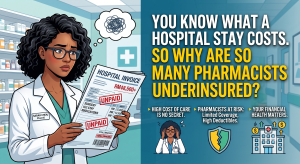
A client of mine — let’s call her Annie — is a 31-year-old private hospital pharmacist in Selangor. Solid salary, diligent EPF contributor, even started a small unit trust portfolio last year. By most measures, she is doing the right things.
When I reviewed her insurance, I found she had a medical card with an annual limit of RM50,000. She got it when she first started working six years ago and never looked at it again.
“That should be enough, right?” she asked. “I work in a hospital. I know how this stuff works.”
She did know how it worked. That was exactly the problem. She had watched patients get billed RM80,000 for a single cardiac procedure. She knew what a week in ICU costs. She had counselled patients on their discharge medications after surgeries that ran well past her annual limit — in one visit.
And yet, like many pharmacists I speak to, she had never applied that knowledge to herself.
Medical Inflation in Malaysia Has Quietly Broken Your Old Coverage
Here is the number that should concern you: Malaysia’s medical inflation rate is projected at approximately 16% in 2026. That is not the general cost of living going up. That is the cost of healthcare specifically — procedures, ward charges, specialist fees, medications — rising at 16% a year.
To put that in perspective: if a treatment cost RM50,000 in 2020, that same treatment is estimated to cost well over RM90,000 today. In six years. A policy that felt adequate when you bought it may now leave you with a five- or six-figure shortfall.
| Malaysia Medical Inflation Rate (2026): ~16% Asia-Pacific average medical inflation (2026): ~11.3% Malaysians who surrendered or terminated health insurance policies since 2024: Over 340,000 Sources: Aon 2026 Global Medical Trend Rates Report; CodeBlue/Galen Centre (Feb 2026) |
Over 340,000 Malaysians have dropped their health insurance policies since 2024 — largely because the premiums became unaffordable as insurers passed rising healthcare costs onto policyholders. Many of those people are now unprotected.
If you still have your policy, that is good. But when did you last check whether the coverage still makes sense — and does your situation as a government or private sector pharmacist change that answer? Let’s break both down.
The Group Insurance Trap
Many pharmacists working in government hospitals or larger private healthcare groups receive group medical insurance from their employer. It feels like a benefit — because it is. But it comes with limitations that most people only discover when they need to make a claim.
Group coverage typically ends the day you leave the organisation. If you resign, retire early, or move to a locum arrangement, the policy does not follow you. You are back to square one — and by that point you may be older, carrying a pre-existing condition declared by your medical history, and facing higher individual premiums than you would have paid a decade earlier.
Group policies also tend to have lower annual limits than individual policies, fixed panel hospital lists, and less flexibility on room and board entitlements. They are designed for a workforce, not for an individual’s specific health profile and risk.
“Group insurance from your employer is a safety net. It is not a retirement plan for your health coverage. The moment you stop working there, it disappears.”
For contract pharmacists especially — and there are tens of thousands of you across the public and private sector — the employment picture is already uncertain enough. Building your healthcare protection around a contract position is not a plan. It is a risk.
“But I’m a Government Pharmacist — Won’t Kad Pesara Cover Me?”
This is the question I get most often from government pharmacists, and it’s a fair one. If you retire from the public service, you are issued a Kad Pesara — a pensioner’s card from JPA and KWAP that entitles you to free treatment at government hospitals and government health clinics for life. Your spouse is covered too, and so are your children under 18 (or with no age limit if they are disabled). Your ward class is even determined by your last drawn grade — a senior pharmacist retiring at Grade 14 or above, for instance, typically qualifies for a higher class of ward.
That is genuinely valuable. It is one of the strongest retirement benefits in the Malaysian public sector, and it is worth factoring into your planning.
But it comes with one condition that changes the calculation: it only applies at government hospitals and government clinics. Kad Pesara does not cover treatment at private hospitals.
For many retirees, that is a fine trade-off — government hospitals in Malaysia have strong clinical capability, and the cost savings are real. But think honestly about how you and your family actually behave today. If a loved one falls seriously ill, do you currently take them to the nearest government hospital and wait, or do you head to a private specialist for faster access and choice of consultant? Most people who have the means choose private care, at least for anything urgent or specialised. Retirement does not usually change that instinct — it just removes the coverage that used to pay for it.
There is also a timing gap worth naming. Kad Pesara benefits apply after you retire. Between now and your mandatory retirement age of 60, you are not yet covered by it — you are relying entirely on whatever medical insurance you hold during your working years, whether that’s a group policy, an individual policy, or nothing at all.
“Kad Pesara is a genuine benefit worth planning around — but it is a government-hospital benefit, not a full replacement for private medical coverage. The two can coexist in your plan.”
For a government pharmacist, the more useful question is not “insurance or Kad Pesara” but how the two work together. Some retirees are entirely comfortable relying on Kad Pesara and choose not to carry private medical insurance into retirement — that is a legitimate decision, particularly if premiums become expensive at older ages. Others prefer to keep a scaled-down private policy specifically so they retain the option of private treatment when it matters most, with Kad Pesara as the fallback. Neither answer is universally right; it depends on your risk tolerance, your family’s health history, and what you can comfortably afford to keep paying in your 60s and 70s.
What matters is that the decision is made deliberately — not by default, simply because a group policy from your working years quietly lapsed the day you retired.
What the New MHIT Rules Mean for You
In late 2024, Bank Negara Malaysia stepped in to manage the situation. Insurers were told to spread premium increases over a minimum of three years, with annual hikes generally capped to avoid sudden large increases. A standardised base plan for Medical and Health Insurance/Takaful (MHIT) was also introduced, along with a published price reference guide for 26 common medical procedures — so consumers can better compare what they are actually buying.
This is good news, broadly. But it also means premiums are going up — just more gradually than before. Waiting to review your policy does not make it cheaper. It just delays the conversation.
The Three Questions Every Pharmacist Should Be Asking
1. What is my annual limit — and is it still realistic?
Pull out your policy document or call your insurer. Find the annual limit — the maximum the policy will pay out in a single policy year. Then think honestly: if you were admitted tomorrow for a cardiac event, a cancer diagnosis, or a serious accident, would that limit cover the full treatment course?
For most conditions requiring surgery, specialist follow-up, and inpatient stay, a minimum annual limit of RM150,000 is a more sensible starting point in 2026. If your policy is significantly below that, it is worth reviewing.
2. Am I relying on a policy I got years ago without reviewing it?
This is the most common situation I see. The policy was adequate when it was purchased. Life moved on. Salaries went up, lifestyle adjusted, family expanded — but the medical card stayed the same. Meanwhile, healthcare costs compounded quietly in the background.
A policy review is not the same as buying new insurance. It is simply checking whether what you have still matches what you need.
3. Does my coverage move with me if I change jobs?
If the answer is no — if your medical coverage is entirely tied to your current employer — then you have a gap in your personal financial plan. Not because the group policy is bad, but because it is not yours.
An individual medical policy, bought while you are young and healthy, is portable. It follows you through career changes, transitions to locum work, or early retirement. That portability is worth something.
What About the Cost?
Premium costs vary by age, health history, coverage level, and insurer — which is why general figures can be misleading without your specific context. What I can say is that for a pharmacist in their late 20s to early 30s in good health, individual medical coverage with a meaningful annual limit is generally very achievable within a budget that makes sense relative to income.
There is also a tax angle worth knowing. Medical and health insurance premiums qualify for a separate tax relief of up to RM4,000 per year — distinct from the RM7,000 combined relief bucket for life insurance and EPF contributions. If you are already maxing out your EPF and life insurance relief, this RM4,000 is still available to you.
| Tax Relief Category | Maximum Relief (YA2026) |
|---|---|
| Life insurance premiums + EPF contributions (combined) | RM7,000 |
| Medical & health insurance / takaful premiums | RM4,000 |
| Critical illness insurance (included under medical relief) | RM4,000 (shared) |
The Irony Worth Sitting With
You dispense medication every day. You counsel patients on discharge planning. You watch families navigate unexpected diagnoses and the financial aftermath that follows. You know, more than most, that the worst medical outcomes are rarely planned.
And yet the research — and my own conversations with pharmacists across the country — consistently shows that healthcare professionals are among the groups most likely to underestimate their own personal insurance needs. Partly because the knowledge can create a false sense of control. Partly because it is easier to think about patients than ourselves.
Knowing what a hospital stay costs does not protect you from the bill. Having the right coverage does.
This is not meant to cause alarm. Most pharmacists I work with are one straightforward review away from being in a much stronger position. It just requires setting aside the time to actually do it.
If you are not sure where to start, that is exactly what I am here for.
Uncertain about your insurance coverage?
I offer a complimentary, no-obligation conversation for healthcare professionals who want to review their financial plan — including whether their medical coverage still makes sense in 2026.
📩 Just pick a slot by clicking the button below and I will reach out to you.
Or, join my email list by clicking here if you are not ready to connect yet.
Disclaimer: This post is for informational purpose only. You should use judgment and conduct due diligence before taking any action or implementing any plan suggested or recommended in this article.