


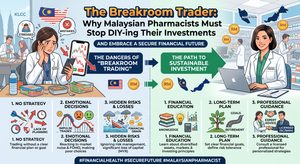
As a pharmacist, you are trained to handle immense complexity. Whether you are managing ward rounds in a hectic public hospital (KKM), supervising senior retail staff at a community pharmacy, or cross-checking dosage levels under intense pressure, your attention to detail is your superpower.
Because of this, many pharmacists carry a core belief when it comes to their personal wealth: “Since I can master complex clinical guidelines, I can easily manage my own investment portfolio in my spare time.”
It makes logical sense on paper. You are analytical, comfortable with numbers, and highly educated. You buy a few recommended books on value investing, follow financial forums, open a global brokerage account, and prepare to manage your RM 200,000+ portfolio on your own during your breaks.
But there is a hidden, dangerous flaw in this belief—and it is costing Malaysian pharmacists both their peace of mind and their hard-earned capital.
The Hidden Flaw: The High Cost of Cognitive Fatigue
The flaw is not a lack of intelligence. The flaw is time scarcity and executive exhaustion.
Active investing—trying to time the market, picking individual stocks, or constantly shifting global ETF allocations—is not a passive hobby. It is an active, demanding discipline that requires calm, undistracted focus.
But as a pharmacist, your day looks very different:
- You stand on your feet for 10 to 12 hours a day.
- You endure exhausting back-to-back retail shifts and weekend locum hours to boost your income.
- Your brain is in a constant state of hyper-vigilance to prevent clinical errors.
By the time you get a 15-minute tea break or sit down at 9 PM after a grueling shift, your executive functioning is completely depleted. Trying to make high-stakes, unemotional investment decisions in a state of chronic fatigue is a recipe for emotional trading mistakes.
When you DIY your active investments on the side, you aren’t just investing money—you are trading your rare, precious downtime for a second, highly stressful part-time job.
Wei Sheng’s Story: The RM 18,000 Work Round
To make this hidden flaw concrete, let’s look at the story of Wei Sheng, a senior retail pharmacist in Selangor (a representative scenario I see all too often).
Wei Sheng wanted to build a comfortable retirement nest egg so he could eventually step back from long retail shifts. He decided to take the DIY route, managing a portfolio of high-growth US tech stocks and global ETFs on a mobile trading app. He would check his portfolio on his phone during quick dispensary breaks and place trades between patient consultations.
One Tuesday, his pharmacy was short-staffed. Wei Sheng spent the afternoon running a non-stop pharmacy, dealing with inventory delays, and handling an influx of patients. Meanwhile, across the world, a sudden macro-economic announcement triggered a sharp correction in tech stocks.
By the time Wei Sheng finally logged into his app during his late-night break, his portfolio was deep in the red. Exhausted, stressed, and panicking, his clinical logic flew out the window. He executed a panic-sell at the very bottom of the market to “limit the damage”—wiping out RM 18,000 in a single day.
The market recovered a week later, but Wei Sheng’s money was gone.
The tragedy of Wei Sheng’s loss wasn’t that he was uninformed. It was that he tried to operate as an active trader in the margins of an already high-stress medical career. His clinical job demanded 100% of his focus; his investments received whatever scraps of energy he had left.
MyFinTalk Insight: Shift from Active Chores to Structured Systems
At MyFinTalk, we believe you need to look at wealth management through the lens of trade-offs, not just final returns.
When you choose the active DIY path, you are trading your weekends, your mental clarity, and your sleep to chase a marginal return that often vanishes during the first market bump. Is that trade-off actually helping you live a better life?
True financial freedom does not come from having a second job as a breakroom day-trader. It comes from turning your financial planning from an active, exhausting chore into a passive, automated background system.
Consider the two paths side-by-side:
| Active DIY Investing (The Trade-off) | Automated Wealth Management (The Solution) |
|---|---|
| Active Time Drain: Glued to stock charts during clinic breaks and weekends. | Time Reclaimed: Your investments run quietly in the background while you rest. |
| Emotional Vulnerability: Chronic shift fatigue leads to panic-selling or missing market shifts. | Discipline on Autopilot: Rules-based rebalancing eliminates emotional error. |
| Anxiety & Overwhelm: Constantly worrying if your EPF, cash reserves, and stocks are aligned. | Structural Alignment: A clear, master blueprint ensuring every RM is optimized. |
As a licensed financial planner in Malaysia, my job isn’t to give you homework or teach you how to trade stocks on your phone during your working hours. My job is to take wealth management completely off your to-do list.
We build a structured, robust, and tax-efficient portfolio that respects your high-income bracket, coordinates with your EPF compounding, and runs entirely on autopilot. This allows you to focus 100% on your patients, excel in your career, and—most importantly—get your weekends back to enjoy with your family.
Your Invitation: Take Your Wealth Off Autopilot’s To-Do List
You have spent years mastering the science of medicine to care for others. It is time to let a professional system care for your financial future.
If you are a busy Malaysian pharmacist with RM 200,000 or more in investable assets (including cash, unit trusts, and stocks), let’s see if we are a good fit to work together.
I invite you to book a Free Financial Strategy Call with me.
On this low-pressure, 30-minute Google Meet call, we will:
- Assess your current financial layout (including how your EPF and private investments are currently working together).
- Identify any invisible gaps or “blind spots” that shift fatigue might be hiding from you.
- Explore what a tailored, done-for-you wealth system looks like for your specific career path—whether you are aiming for KKM transition or early retirement.
There is no sales pitch, no corporate jargon, and no judgment about past financial mistakes. Just a clear, supportive conversation to see how we can put your financial planning on autopilot.
Just schedule a meeting by clicking the button below. I will reach out to you and see if we would be a good fit for each other.
Or if you are not ready yet, join my email list to receive useful information to improve your finances by clicking here.
Disclaimer: This page is for informational purpose only. You should use judgment and conduct due diligence before taking any action or implementing any plan suggested or recommended in this article. Speak to a professional about your specific circumstances.