


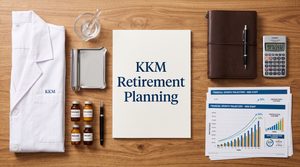
Ask any young government pharmacist why they chose to stay in public service after completing their PRP and compulsory service, and you will almost certainly hear the same answer:
“The pay is stable, and at the end of the day, I have a government pension for life.”
It is comforting to believe that decades of ward rounds, sterile cleanroom shifts, endless outpatient dispensing queues, and Saturday on-calls will automatically translate into a worry-free retirement. After all, the public sector guarantees a monthly pension, a lump-sum gratuity, and free healthcare under the Kad Pesara.
There is just one problem: most government pharmacists drastically overestimate how much their pension will actually pay.
When you retire from the Ministry of Health (KKM), your pension does not replace your salary. In fact, for the vast majority of officers under the Public Service Remuneration System (SSPA Gred UF9 hingga UF14), the pension replaces less than 50% of their actual pre-retirement take-home pay.
This post breaks down the mathematics behind the KKM allowance gap, what it really means for your retirement lifestyle, and how to bridge the shortfall while you are still climbing the UF grade ladder.
“A government pension gives you a guaranteed floor. It does not guarantee your lifestyle. If you spend your career assuming the government formula will handle 100% of your retirement needs, retirement day will come as an unpleasant financial shock.”
The Illusion of the “60% Pension”
Civil servants are taught that after 30 years (360 months) of reckonable service, their pension pays 60% of their last drawn salary.
Here is the part that many pharmacists miss until they receive their pre-retirement briefing: the pension formula only calculates 60% of your basic salary (gaji pokok akhir). It completely ignores your allowances.
Monthly Pension = 1/600 x 360 months x Last Drawn Basic Salary = 60% x Gaji Pokok
Throughout your pharmacy career in KKM, a substantial portion of your monthly bank deposit does not come from basic salary. It comes from fixed civil service allowances:
- Bayaran Insentif Perkhidmatan Kritikal (BIPK): RM750 every month.
- Imbuhan Tetap Perumahan (ITP): RM300 to RM700+ depending on your grade and posting.
- Imbuhan Tetap Khidmat Awam (ITKA) or Imbuhan Tetap Keraian (ITK): RM300 to RM800+.
- Bayaran Imbuhan Wilayah (BIW): RM360
These allowances are not bonuses—they pay for your mortgage, your children’s education, your groceries, and your family’s lifestyle.
On the day you retire, every single one of these allowances drops to exactly RM0.
Running the Numbers: The KKM Allowance Gap in Practice
Let’s look at what happens to an officer retiring after a full, successful 30-year career reaching Gred UF13 or UF14:
| Income Component | Working Pharmacist (UF14 Tier) | Retired Pharmacist (Skim Pencen) | Difference |
| Basic Salary (Gaji Pokok) | RM10,500 | — | — |
| BIPK (Critical Allowance) | RM750 | RM0 | -RM750 |
| ITP (Housing Allowance) | RM700 | RM0 | -RM700 |
| ITKA (Civil Service) | RM800 | RM0 | -RM800 |
| BIW | RM360 | RM0 | -RM360 |
| Gross Monthly Cash Flow | RM13,110 | — | — |
| Calculated Pension (60% of Basic) | — | RM6,300 | — |
| Net Lifestyle Replacement Ratio | 100% | 48.1% | -51.9% Drop |
⚠️ The Uncomfortable Truth
A retiring UF13/UF14 pharmacist who is accustomed to budgeting around a gross household cash flow of RM13,110 will experience an immediate 51.9% drop in monthly income, receiving RM6,300 per month.
If you are a mid-career UF10 or UF12 pharmacist today, your current lifestyle is already calibrated to your total take-home pay, not your basic salary alone. Expecting your future living costs to drop by half the day you turn 60 is unrealistic—especially when accounting for inflation on food, utility tariffs, and family commitments.
What About the Gratuity (Ganjaran Perkhidmatan)?
Government pharmacists will rightfully point out that retirement comes with a tax-free lump-sum gratuity:
Gratuity = 7.5% x Total Completed Months x Last Drawn Basic Salary
For a pharmacist with 360 months of service and a basic salary of RM10,500, the gratuity delivers approximately RM283,500, plus cash-in-lieu of leave (Gantian Cuti Rehat – GCR, capped at 180 days).
Receiving a lump sum of roughly RM300,000 to RM350,000 feels like a fortune upon retirement. But let’s look at how long it lasts if it is used to plug the monthly allowance gap:
[ Monthly Allowance Deficit: RM6,450 / month ]
                     │
                     ▼
  RM320,000 Gratuity ÷ RM6,450 Monthly Deficit
                     │
                     ▼
       Exhausted in under 4.2 Years!
If you burn through your gratuity simply trying to sustain your pre-retirement living standards, that lump sum will be completely gone by age 64—leaving you dependent solely on the basic pension for the remaining 15 to 25 years of your life.
The Kad Pesara Fallacy: Healthcare vs. Income
The other major anchor keeping pharmacists in government service is the Kad Pesara, which grants subsidised access to KKM clinics and hospitals for life.
Free healthcare is an invaluable safety net. But as a pharmacist, you already understand how the healthcare system works from the inside:
- Kad Pesara covers standard formulary treatments, government ward admissions, and subsidised medications.
- It does not pay for non-formulary novel biologics, specialised surgical implants, or offshore treatments that frequently require out-of-pocket funding, that may or may not be reimbursed.
- Most importantly: Kad Pesara does not pay your utility bills, service your car, buy your groceries, or fund retirement travel.
Medical coverage takes care of hospital bills; it does not replace lost cash flow.
Five Things KKM Pharmacists Must Do to Bridge the Gap
You do not need to leave the civil service to retire comfortably. What you do need is to stop treating the government pension as your entire retirement plan.
1. Calculate Your Retirement Gap Based on Take-Home Pay, Not Basic Salary
Take your current monthly payslip. Subtract your basic salary from your total take-home pay. That difference is your Monthly Allowance Deficit. Your personal investment portfolio must be sized to generate this exact cash flow in retirement so your living standards never drop.
2. Open a Voluntary EPF Account (Caruman Pilihan Sendiri)
Many civil servants on the pension scheme do not realise they can still maintain an active EPF account. You can voluntarily contribute up to RM100,000 per year into your EPF account. Compounding your extra monthly savings or locum income at historical EPF dividend rates (5.3%–6.0%) in a capital-protected environment creates a powerful secondary retirement corpus alongside your pension.
3. Maximise Tax Reliefs (PRS & SSPN) While You Are in Peak Tax Brackets
As a UF10, UF12, or UF14 officer, your marginal tax rate sits between 11% and 25%. Fully utilise the RM3,000 Private Retirement Scheme (PRS) tax relief and the RM8,000 SSPN tax relief every year. The immediate tax refund effectively gives you an instant 11%–25% guaranteed return on your capital, which can be reinvested into global index funds.
4. Own an Independent, Portable Medical & Critical Illness Policy
Do not rely 100% on the KKM facility queue when you are elderly. More critically, ensure you hold private Critical Illness (CI) coverage equal to 3 to 5 times your annual salary. A severe illness during your 40s or 50s will halt your locum earnings and drain your household cash reserves long before you ever reach pensionable age.
5. Automate Investments on Payday
Government salary dates are completely predictable (usually between the 18th and 25th of each month). Set up automatic standing instructions the day after salary clearance into low-cost, globally diversified ETFs or local unit trusts. If you wait to save “whatever is left over” at the end of the month, the money will quietly disappear into lifestyle creep.
The Verdict: Keep the Pension, Build the Bridge
The government pension is a reliable financial foundation. It provides guaranteed, lifetime, longevity-protected income that private-sector workers can only dream of.
However, a foundation is not a complete house. The pharmacists who retire with genuine dignity, freedom, and choices are not the ones who passively waited for their pension to kick in. They are the ones who recognised the allowance deficit early in their careers and systematically built their own private investment bridge to cover it.
Earning a Stable Government Salary but Not Sure If Your Retirement Is Truly Funded?
A guaranteed pension does not automatically equal a secure retirement—especially when your allowances disappear on day one. Book a free 30-minute financial review to calculate your exact pension gap and build a clear plan to bridge it.
Just schedule a meeting by clicking the button below. I will reach out to you and see if we would be a good fit for each other.
Or if you are not ready yet, join my email list to receive useful information to improve your finances by clicking here.
Disclaimer: This page is for informational purpose only. You should use judgment and conduct due diligence before taking any action or implementing any plan suggested or recommended in this article. Speak to a professional about your specific circumstances.