


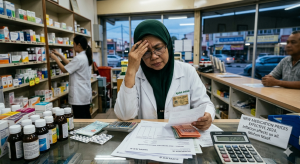
You studied for years, navigated the PRP year, and finally built a stable career as a pharmacist. You’re earning a decent salary, contributing diligently to EPF every month — and somewhere in the back of your mind, you assume that by the time you hit 60, the EPF savings will take care of you.
But will it, really?
Let’s run the numbers honestly — because for most Malaysian pharmacists, the answer is more uncomfortable than expected.
What Are Pharmacists Actually Earning in Malaysia?
Before we can answer the retirement question, we need to know what goes into EPF.
Government Pharmacist — Official SSPA Salary Scale (effective 1 December 2024)
Under the new Sistem Saraan Perkhidmatan Awam (SSPA), government pharmacists are now graded UF9 through UF14, replacing the old UF41–UF54 scheme. The official JPA salary ranges are:
| Grade (SSPA) | Starting Salary | Maximum Salary | Equivalent Role |
|---|---|---|---|
| UF9 | RM 2,910 | RM 11,110 | Entry-level / fresh graduate |
| UF10 | RM 3,840 | RM 12,150 | Mid-level |
| UF12 | RM 5,530 | RM 13,540 | Senior / supervisory |
| UF13 | RM 6,210 | RM 14,370 | Management level |
| UF14 | RM 6,560 | RM 15,360 | Senior management |
Source: JPA SSPA Lampiran D, effective 1 December 2024. Annual salary increment (KGT) for UF9–UF14 ranges from RM 225–RM 320 per increment.
Note: Government pharmacists also receive some allowances, which meaningfully add to total take-home pay — but some of these allowances are not included in EPF calculations, so they do not boost your retirement pot.
Private Sector — Market Rate Estimates
Private sector salaries are harder to pin down with a single authoritative source, but here is a triangulated picture based on Jobstreet, PayScale, and industry surveys:
| Role | Estimated Monthly Salary |
|---|---|
| PRP (Provisionally Registered Pharmacist) | RM 2,700 – RM 3,200 |
| Retail Pharmacist (junior–mid) | RM 3,500 – RM 5,500 |
| Retail Pharmacist (experienced / chain) | RM 5,500 – RM 7,500 |
| Pharmacy Store Manager | RM 6,000 – RM 9,000 |
| Industry / Pharmaceutical MNC | RM 5,500 – RM 12,000+ |
Sources: Jobstreet Malaysia salary insights; PayScale Malaysia 2026; DOSM Human Health sector median RM 3,610 / mean RM 4,501 (Salaries & Wages Survey 2024).
For the retirement projection in this article, we will use RM 6,000/month as a working example — a mid-career pharmacist around 10 years into practice, either at UF10 government level or an experienced retail/chain pharmacist. This sits comfortably in the middle of the realistic range across sectors.
How Much Is Going Into EPF Each Month?
At RM 6,000/month and under age 55, here’s your EPF contribution:
- Employee contribution (11%): RM 660
- Employer contribution (12%): RM 720
- Total monthly EPF contribution: RM 1,380
Over a year, that’s RM 16,560 going into your EPF — before dividends.
EPF has historically declared dividends of around 5–6% annually for Simpanan Konvensional. For 2025, the conventional dividend was 6.15%.
That sounds good. But let’s look at the big picture.
What Do You Actually Need to Retire?
In January 2026, EPF officially launched its new Retirement Income Adequacy (RIA) Framework, replacing the old single-tier RM 240,000 benchmark. The new framework has three tiers:
| Tier | Savings Target (at age 60) | Monthly Withdrawal (Year 1) |
|---|---|---|
| Basic Savings | RM 390,000 | ~RM 1,625/month |
| Adequate Savings | RM 650,000 | ~RM 2,708/month |
| Enhanced Savings | RM 1,300,000 | ~RM 5,417/month |
These figures are designed to sustain you over 20 years (from age 60 to 80), with withdrawals that grow over time to partially hedge against inflation.
The EPF’s own Belanjawanku 2024/2025 guide estimates that a single retiree in Malaysia needs at least RM 2,690 per month just to cover basic living expenses. That corresponds to the Adequate Savings tier — meaning RM 650,000 at retirement is the bare minimum for a decent quality of life.
Now here’s the sobering reality: as of 2025, only 23.9% of all EPF members aged 18–55 have reached the Basic Savings level recommended for their age. Even among members aged 51–55 approaching retirement, fewer than half had met the previous (lower) benchmark.
Pharmacists earn more than the national average — but that doesn’t automatically mean they’re on track.
The Pharmacist EPF Reality Check
Let’s model a typical scenario.
Profile: Pharmacist, starts career at age 24, retires at 60
Assumptions:
- Starting salary: RM 4,500 (post-PRP government)
- Grows to RM 6,000 by age 35, RM 8,000 by age 45, then plateaus
- EPF contributions: 11% employee + 12% employer
- EPF dividend rate: 5.5% per annum (conservative)
- No early withdrawals (housing, education, medical)
Under these assumptions, total EPF savings at age 60 would be approximately RM 750,000 – RM 850,000.
That sounds like a lot. But consider:
- Inflation erodes purchasing power. RM 650,000 today buys much more than RM 650,000 in 2046. You’ll need more, not less.
- Most pharmacists make early withdrawals. Housing purchases under Account 2 can significantly reduce the final balance.
- Your lifestyle likely exceeds RM 2,690/month. As a professional, you’ve probably grown accustomed to a standard of living — perhaps with a car, holidays, private medical care, and supporting children — that costs significantly more.
- Healthcare costs in retirement are unpredictable. The older you get, the higher your medical bills. Without a robust health insurance policy, a single hospitalisation can wipe out months of savings.
- Government pharmacists have pension — but private sector pharmacists are entirely on their own. If you’re in retail or industry, EPF is your safety net.
The verdict? For most private sector pharmacists, EPF alone will deliver a borderline retirement at best — functional, but not comfortable by the standards you’re likely used to.
The Gap Is Real — and Growing
Let’s be specific. If you retire at 60 wanting RM 5,000/month for 20 years (a very modest professional lifestyle, accounting for some inflation), you’d need roughly RM 1 million to RM 1.2 million in retirement savings — depending on investment returns and inflation.
That’s above even the Adequate Savings tier of RM 650,000, and well into the Enhanced Savings territory of RM 1.3 million.
This gap is not a death sentence — it’s a planning problem. And planning problems have solutions.
What Can Pharmacists Do About It?
Here are the key levers to close the retirement gap:
1. Voluntary EPF Top-Ups (i-Saraan / Extra Contribution)
You can contribute more than your mandatory 11%. Every extra ringgit goes into your retirement account and earns tax-free EPF dividends. You also get an income tax relief of up to RM 7,000/year on EPF contributions.
2. Private Retirement Scheme (PRS)
PRS allows additional tax-deductible contributions (up to RM 3,000/year relief) into approved funds that invest in equities, bonds, and mixed assets. This is especially useful if you want market-linked returns beyond EPF’s fixed dividend.
3. Unit Trust / Equity Investment
A pharmacist earning RM 6,000 who invests just RM 800/month into a diversified equity fund returning 8% per annum will accumulate approximately RM 1.1 million over 30 years. Combined with EPF, that’s a very different retirement picture.
4. Adequate Life and Health Insurance
Protecting against catastrophic medical events keeps your retirement savings intact. A comprehensive medical card and critical illness policy is not optional for a healthcare professional — it’s the foundation of any solid financial plan.
5. Plan Around the New EPF Tiers
Use the RIA Framework as a personal benchmark. If you’re 35 and your EPF balance is significantly below the age-based Basic Savings target, that’s your signal to act — not panic, but plan.
A Note for Government Pharmacists
If you’re on the pensionable scheme, you have a structural advantage: your pension provides ongoing income regardless of EPF withdrawals. But don’t let that create complacency. Pension amounts are often lower than expected, cost-of-living adjustments are modest, and private medical costs in retirement are still your responsibility. A pension is a floor — not a ceiling.
The Bigger Picture
Pharmacists occupy a privileged position in Malaysia’s workforce. Your income is above average, your employment is stable, and your career longevity is relatively high. All of that should translate into a comfortable retirement — but only if the money is deployed strategically.
The hard truth is that EPF, on its own, will likely get you to survivable — not comfortable. Closing the gap requires intentional saving, smart investing, and ideally, working with a qualified financial planner who understands the specific needs of healthcare professionals.
You spend your career helping patients understand what’s best for their health. It’s worth applying the same rigour to your own financial health.
Thinking about whether your current financial plan is enough for the retirement you want? Speaking with a licensed financial planner can help you map out a clear strategy — one built around your actual salary, timeline, and lifestyle goals.
Reach out for a complimentary consultation. No jargon, no pressure — just an honest look at your numbers.
📩 Just leave your details by clicking the button below and I will reach out to you.
Or, join my email list by clicking here if you are not ready to connect yet.
Disclaimer: This post is for informational purpose only. You should use judgment and conduct due diligence before taking any action or implementing any plan suggested or recommended in this article.