
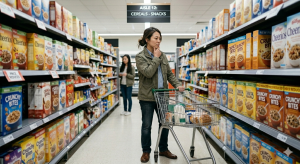
Let me guess.
You walk into Lotus’s or AEON with a rough budget in your head — maybe RM300 for the week’s groceries. You grab the usual stuff. Biscuits for the kids. 3-in-1 coffee for your night shift. Sweet soy sauce for your ayam masak kicap.
Then you reach the cashier.
Total: RM412.
And your trolley looks emptier than two years ago.
You’re not crazy. You’re not bad at budgeting. You’re just getting shrinkflated.
What the heck is shrinkflation? (In case you haven’t googled it at 1am)
Two things:
- Shrinkflation — same price, but the pack gets smaller. Your 500ml kicap becomes 420ml. You don’t notice because the bottle looks similar.
- Skimpflation — same pack, same price, but they swap real ingredients for cheaper crap. Your kopi 3-in-1 now has more sugar, less coffee.
Headline inflation says 3%. But your actual grocery bill? Feels like 15-20%.
So let’s stop blaming yourself. Let’s build a grocery budget that fights back.
1. Be a detective for 5 minutes (you’re a pharmacist — you got this)
You check drug interactions before dispensing. Do the same with grocery price labels.
Here’s the trick:
Ignore the big price tag. Calculate the RM per 100g or RM per 100ml.
Example:
- Old shampoo: 500ml @ RM15 → RM3 per 100ml
- New “same price” shampoo: 420ml @ RM15 → RM3.57 per 100ml
You just lost 19% value. For nothing.
Your new rule: Never buy the “new look, same price” item without checking the per 100ml number first.
Pro tip: Snap a photo of the unit price for your top 10 staples (cooking oil, coffee, detergent). Compare every 3 months. That’s your real inflation rate.
2. The 80/20 Pantry Reset (very easy, I promise)
Here’s a truth bomb: You cannot shrink local rice. You cannot skimp on eggs.
Shrinkflation only works on processed stuff — biscuits, cereal, instant noodles, boxed drinks.
So flip your budget:
- 80% local staples → Local rice, eggs, seasonal vegetables (kangkung, bayam), tofu, tempeh, anchovies, seasonal fruits.
- 20% processed convenience → Biscuits, 3-in-1 coffee, instant noodles, boxed cereal.
Why this works for you (especially as a pharmacist):
You already know processed food is bad for your health. Now you know it’s bad for your wallet too.
So next time:
- Swap one box of sweet cereal for rolled oats. Same volume, half the price, zero shrinkflation.
- Buy seasonal vegetables (the cheapest greens of the week) instead of frozen fried vegetable mix.
Your body and your bank account will thank you.
3. Real example: See your ringgit disappear (this one hurts)
I can’t give you exact prices from 2024 because I don’t have my old receipts anymore. And honestly, different stores and different brands shrink at different times.
But here’s what I have seen with my own eyes over the last two years:
- A popular brand of sweet soy sauce that used to be 500ml is now 420ml. Same price.
- A well-known coffee mix that used to come in 12g sticks is now 10g sticks. Same number of sticks. Same price.
- A family pack of biscuits that weighed 300g now weighs 250g. You guessed it — same price.
Do the math with me:
If you lose 50g here, 80ml there, 2g per coffee stick — it adds up. On just five or six items, you’re probably paying 5 to 8 ringgit more for less stuff.
Now multiply that by 30 items in your trolley. That’s 50 to 80 ringgit missing every week.
No wonder you feel like your money is leaking.
Here’s what you can do: Next time you’re at the store, compare a product you’ve bought for years with an old photo on your phone (or even an old receipt). You’ll see the difference yourself.
4. Your free “Shrinkflation Tracker” (print and keep in your wallet)
You’re a planner. You like data. (I see you, spreadsheet queen.)
Here’s a simple tracker you can print or screenshot.
How to use:
- Pick 10 things you buy every single week (Dutch Lady milk, Gardenia bread, Dynamo, etc.)
- Every 2 months, write down the weight/volume and price.
- If the weight goes down but price stays same → red flag.
Sample table (copy this into your Notes app or WhatsApp yourself):
| Item | Date | Weight/ Volume | Price | RM per 100g | Shrink? |
|---|---|---|---|---|---|
| Biskut Marie | Jan 2026 | 250g | RM4.60 | RM1.84 | Yes |
| Dutch Lady UHT | |||||
| Gardenia Bread | |||||
| Dynamo |
Keep this in your wallet/purse. Pull it out before you put stuff in the trolley.
A quick note to healthcare professionals
I know your life.
You manage meds stock. You handle patients who don’t listen. You work shift hours. You’re tired.
The last thing you need is to come home and realise you paid more for less groceries.
Shrinkflation is silent. No announcement. No news headline. But it steals from your future — every RM5 lost to a smaller pack of coffee is RM5 NOT going into your ASB, KWSP i-Saraan, or that emergency fund you keep meaning to build.
Your 3-step action plan for this week (super simple):
- Look at your pantry. Which packs look smaller than last year? Write them down.
- Shift your 80/20. More seasonal vegetables. Fewer shrinkable snacks.
- Start your tracker. Just 10 items. Keep it in your wallet/purse or phone.
You can’t control what manufacturers do. But you can control your awareness.
Let’s protect your ringgit, one grocery run at a time.
Need help with the rest of your budget?
If shrinkflation is messing with your grocery budget, chances are other parts of your spending are leaking too.
I help healthcare professionals build simple cash flow plans that account for real life (not some idealistic budget from a book).
Let’s chat for 20 minutes — free, no pressure, like coffee with a friend who happens to be a financial planner.
📩 Just leave your details by clicking the button below and I will reach out to you.
Or, join my email list by clicking here if you are not ready to connect yet.
Disclaimer: This post is for informational purpose only. You should use judgment and conduct due diligence before taking any action or implementing any plan suggested or recommended in this article.
