
A pharmacist client — a 29-year-old working in Johor — asked me a version of this question last month: “I have an extra RM500 a month. My colleague says just put it all in ASB. My friend who’s into investing says unit trusts will grow faster. Who’s right?”
Both of them, actually — depending on what she’s trying to do with the money. This is one of those questions where the “correct” answer isn’t a single fund. It’s understanding what each instrument is actually built for, and then deciding based on your own situation.
Let’s break it down properly.
What ASB Actually Is
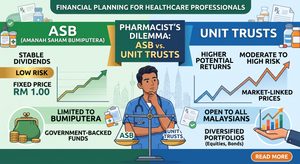
Amanah Saham Bumiputera (ASB) is a fixed-price unit trust managed by Permodalan Nasional Berhad (PNB), exclusively for Bumiputera Malaysians. Unlike most investments, its unit price is fixed at RM1.00 — it doesn’t fluctuate day to day like a share price or a market-linked fund would. Your capital is effectively protected, and each year PNB declares a distribution (dividend plus, in most years, a bonus) that gets credited straight into your account.
For FY2025, ASB declared a total distribution of 5.75 sen per unit — 5.20 sen dividend plus 0.55 sen bonus — an effective return of 5.75%, matching FY2024’s rate. Over the past decade, ASB’s total returns have ranged from around 5.00% to 8.25% annually, though the general trend over the last several years has settled in the 5% to 5.75% range.
For its dividend history, you may refer to this table (click here).
| ASB FY2025 total distribution: 5.75 sen per unit (5.20 sen dividend + 0.55 sen bonus) Individual investment ceiling: RM300,000 Minimum to start: RM10 Sales charge / annual fee to you: None — management cost is absorbed inside the fund before the rate is declared Sources: PNB/ASNB declarations, December 2025 |
There’s no sales charge, and no separate annual fee gets billed to you directly — the fund’s management cost is already absorbed before the distribution rate is announced, so what you see is what you keep. There’s an individual holding ceiling of RM300,000, and importantly, ASB is only open to Bumiputera Malaysians. If you’re not eligible for ASB, ASNB’s equivalent fixed-price options for non-Bumiputera investors are Amanah Saham Malaysia (ASM) and its variants — similar structure, slightly different return history.
What a Unit Trust Actually Is
“Unit trust” is a broader category — it refers to any pooled investment fund managed by a fund house (Public Mutual, AmInvest, Principal, and dozens of others), where your money is combined with other investors’ and put into a portfolio of shares, bonds, or other assets, based on the fund’s stated objective.
Unlike ASB, a unit trust’s unit price (NAV) moves with the market. If the underlying assets go up in value, your units are worth more. If they fall, your units are worth less. There’s no guarantee your capital is protected — that’s the trade-off for potentially higher long-term growth. Equity-focused unit trusts, in particular, can significantly outperform ASB over a long horizon, but they can also have years of negative returns.
Fees matter more here than with ASB. Buying through a bank or agent typically means a sales charge of 3% to 6% up front — meaning if you put in RM10,000, only RM9,400 to RM9,700 actually gets invested on day one. On top of that, most unit trusts charge an ongoing annual management fee of roughly 1% to 2% of your investment value, deducted continuously regardless of how the fund performs.
“ASB is a fixed-price fund with your capital protected and a modest, steady return. A unit trust is a flexible category of market-linked funds with higher growth potential — and the fees to match.”
Side-by-Side: The Practical Differences
| Feature | ASB | Unit Trust (general) |
|---|---|---|
| Eligibility | Bumiputera Malaysians only | Open to all Malaysians |
| Unit price | Fixed at RM1.00 | Variable (NAV moves with market) |
| Capital protection | Effectively yes | No — value can fall |
| Recent return | 5.75% (FY2025) | Ranges widely by fund and market cycle |
| Sales charge | None | 0%–6% depending on platform |
| Annual fee | Embedded, no separate bill | Typically 1%–2% p.a., billed continuously |
| Investment ceiling | RM300,000 per individual | No ceiling |
| Fund choice | One fund | Hundreds of funds across asset classes and regions |
The ASB Financing Angle
One thing that comes up often with pharmacists specifically — because you have a stable, verifiable income that banks like — is ASB Financing (ASBF), where you take a loan specifically to invest in ASB. The logic: if ASB’s declared rate comfortably exceeds the bank’s lending rate, the spread works in your favour.
With current bank effective lending rates sitting around 4.4% to 4.75%, and ASB declaring 5.75%, the spread has generally been positive — somewhere around 1.00 to 1.35 percentage points. That is real, but it is also not guaranteed. ASB’s rate is declared annually and can change; if it drops in a future year, the spread narrows or disappears, and you are still committed to the loan repayment regardless of what ASB pays out that year.
ASB Financing can make sense as part of a broader plan, but it should never be treated as a guaranteed arbitrage. It is leverage, and leverage cuts both ways.
So Which One Should You Actually Use?
If you’re Bumiputera and eligible for ASB
For most pharmacists in this position, ASB is a sensible place to build a stable, low-risk savings base — particularly for money you want to keep relatively safe, or for medium-term goals like a house down payment or an emergency buffer beyond your immediate cash savings. Once you’re closer to the RM300,000 ceiling, or if you want more growth potential for long-term goals like retirement 25 to 30 years away, that’s where diversifying into unit trusts — particularly equity-focused ones with real long-term growth potential — becomes worth considering.
If you’re not eligible for ASB
Your fixed-price alternative through ASNB is ASM or its variants, which offer a broadly similar structure, but the quota may limit your purchasing. Beyond that, unit trusts become your primary vehicle for structured, professionally managed investing — and the fee difference between buying through a bank versus an online platform is significant enough that it’s worth comparing before you commit.
For most pharmacists, the honest answer is: both, in sequence
A framework that tends to work well: build your emergency fund first, maximise EPF and (if eligible) ASB as your low-risk foundation, then use unit trusts — or direct equities, if you’re comfortable with the added complexity — for the portion of your portfolio meant to outpace inflation and medical cost increases over the long run. ASB alone, even at a good year’s rate, is unlikely to be enough to fund a comfortable retirement or keep up with rising healthcare and living costs on its own.
The RM500 a month my client was deciding what to do with didn’t need to go entirely into one or the other. Once we mapped out her actual goals — a house in five years, retirement in thirty — the answer became a split, not a single choice.
That’s usually how it works. The fund isn’t the strategy. The plan is.
Not sure how to split your investments?
I offer a complimentary, no-obligation conversation for healthcare professionals who want a clear plan for where their money should actually go — ASB, unit trusts, EPF, or a mix of all three.
Just schedule a meeting by clicking the button below. I will reach out to you and see if we would be a good fit for each other.
Or if you are not ready yet, join my email list to receive useful information to improve your finances by clicking here.
Disclaimer: This page is for informational purpose only. You should use judgment and conduct due diligence before taking any action or implementing any plan suggested or recommended in this article. Speak to a professional about your specific circumstances.
