
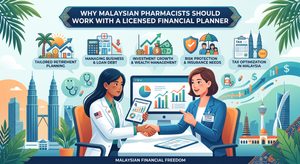
You spent years earning your degree, sitting your PRP exams, and building the clinical judgment to catch a dangerous drug interaction before it reaches a patient. Nobody would dream of asking an unlicensed person to counsel a patient on their medication. Yet many pharmacists happily take financial advice from whoever’s selling — a friend’s insurance agent, a bank counter staff hitting a quarterly target, or a “financial influencer” on TikTok.
Your money deserves the same standard of care as your patients do. Here’s what that actually means, and why it matters more for pharmacists than most other professionals.
“Licensed” Is Not a Marketing Word — It’s a Legal Status
In Malaysia, anyone providing genuine financial planning advice — not just selling a product, but assessing your full financial picture and recommending a strategy — is expected to hold a Capital Markets Services Representative’s Licence for Financial Planning (CMSRL-FP), issued by the Securities Commission Malaysia (SC). Advisers dealing specifically in insurance and takaful products separately need to be registered as a Financial Adviser’s Representative (FAR) under Bank Negara Malaysia’s framework.
This licensing exists for the same reason PRP exists in your own profession: to filter out people who haven’t demonstrated the competence to be trusted with something that can seriously harm you if handled badly. A licensed planner has passed regulatory exams, is bound by conduct rules, and can be checked on the SC’s public register of licensed and registered persons. An “agent” pushing a single insurer’s product range usually isn’t required to meet the same bar — and has a structural incentive to recommend whatever pays the best commission, not whatever fits you.
Before you take financial advice from anyone, it’s worth asking directly: what licence do you hold, and can I verify it? A planner who can’t answer that clearly is not someone you should be handing your EPF statement to.
Why Generic Advice Doesn’t Fit a Pharmacist’s Career
A financial planner who mostly advises office executives on a flat monthly salary will miss things that matter a great deal to you:
- Your income shape isn’t uniform across the profession. A government pharmacist on the SSPA grade structure (UF9 upward) has a pension and predictable increments. A community or hospital-chain pharmacist is EPF-only, with no pension safety net. A locum or pharmacy-owning pharmacist has irregular, self-employed-style income that needs entirely different tax and cash-flow planning. The right EPF and retirement strategy for one of these can be the wrong one for another — a planner needs to know which pharmacist you are before giving advice.
- Career decisions carry financial trade-offs that are specific to pharmacy. Moving from a government post to private practice, taking on locum shifts, or opening your own pharmacy each change your risk exposure, your retirement savings mechanism, and your insurance needs in ways a generalist adviser won’t automatically flag.
- Regulatory and tax details shift yearly, and a good planner tracks how each Budget’s changes — reliefs, EPF rules, SOCSO/SKBBK provisions — actually apply to your situation, rather than giving you a one-size-fits-all checklist.
None of this means you need a planner who specializes in pharmacists. It means you need one who takes the time to understand your specific income structure and career stage before recommending anything.
What a Licensed Planner Actually Does For You
1. Builds a plan around your whole financial life, not one product. A license to do financial planning means the adviser’s job is to look at your income, debts, insurance, EPF and other retirement savings, and goals together — and only then decide what, if anything, needs to change. Compare that to walking into a bank and being offered whatever investment-linked policy is being promoted that month.
2. Is accountable to a regulator, not just to you. If a licensed planner gives you negligent or self-serving advice, there’s a regulatory body and a paper trail. That accountability is a real, structural protection — not just a claim on a business card.
3. Helps you avoid the two most common pharmacist money mistakes. In practice, these tend to be: under-insuring because a workplace group policy feels like “enough,” and assuming EPF alone will fund a comfortable retirement without ever running the actual numbers for your specific track (government pension vs EPF-only vs self-employed).
4. Gives you a second, informed opinion before big decisions. Buying your first home, deciding whether to leave a locked-in tenure post, opting in or out of a scheme like SKBBK, planning for your own pharmacy — these are decisions worth pressure-testing with someone whose job is to look at the numbers dispassionately, not someone with a product to sell you.
A Quick Way to Tell Who You’re Talking To
| Licensed Financial Planner (CMSRL-FP) | Bank/Insurance Product Agent | |
|---|---|---|
| Regulated by | Securities Commission Malaysia | Product provider’s internal training |
| Scope of advice | Whole financial picture | Usually one product category |
| Verifiable on public register | Yes | Not always |
| Compensation structure | Fee, commission, or hybrid — should be disclosed upfront | Commission on what’s sold |
| Obligation | To act in your interest | To sell within their mandate |
The Bottom Line
You wouldn’t accept unlicensed clinical advice, and you wouldn’t want a patient to either. Your finances are worth the same standard: someone who is actually licensed, actually accountable, and actually willing to understand a pharmacist’s career before recommending anything.
If you’d like a second opinion on where you currently stand — EPF trajectory, insurance coverage, tax position, or a specific decision you’re weighing — a free initial consultation is a low-cost way to find out whether your current plan holds up.
Want to know what a financial planner offers?
I offer a complimentary, no-obligation conversation for healthcare professionals who want a clear plan for their finances.
Just schedule a meeting by clicking the button below. I will reach out to you and see if we would be a good fit for each other.
Or if you are not ready yet, join my email list to receive useful information to improve your finances by clicking here.
Disclaimer: This page is for informational purpose only. You should use judgment and conduct due diligence before taking any action or implementing any plan suggested or recommended in this article. Speak to a professional about your specific circumstances.
